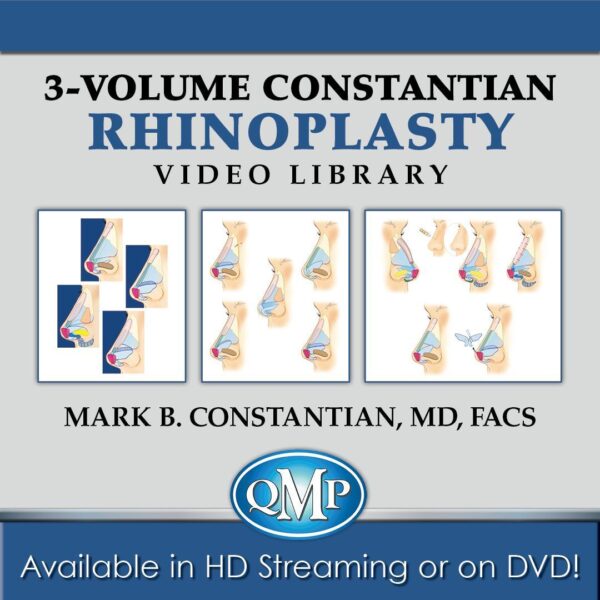
Constantian Rhinoplasty Video Library, Volumes 1, 2, & 3

Original price was: 660.00 $.120.00 $Current price is: 120.00 $.
Constantian Rhinoplasty Video Library, Volumes 1, 2, & 3: operative video teaching on endonasal techniques, primary rhinoplasty, revision planning and grafting.
Delivery Information: This Product is shared via google drive download link. Please use your correct Gmail address at checkout.
Please note: there are no CME points or certificate associated with this course.
Samples for Courses Can be found here: Free Samples Here!
Constantian Rhinoplasty Video Library, Volumes 1, 2, & 3
The Constantian Rhinoplasty Video Library presents operative teaching by Mark Constantian, MD, on primary and revision rhinoplasty. The series discusses diagnostic assessment, operative planning and grafting approaches.
Endonasal Rhinoplasty Teaching
Review recorded demonstrations of primary and secondary rhinoplasty. Educational videos do not replace supervised surgical training or establish competence to perform a procedure.
- Volume 1: Dr. Constantian shares his internal and external diagnostic examination for each case, which translates into an exact surgical plan. The only change to this plan is determined intraoperatively if accommodations must be made because of graft substance and quality. In each case Dr. Constantian demonstrates his step-by-step technique for correcting the deformity with donor materials, ranging from septal and ear cartilage to rib cartilage. The first volume focuses on operative planning and the use of donor cartilage for reconstructive teaching.
- Volume 2: Join Dr. Constantian in the OR as he corrects a variety of problems using closed rhinoplasty techniques. Each procedure is essentially uncut, real-time surgery, demonstrating the great efficiency of limited, purposeful dissection. Full preoperative discussion of presenting problems and surgical plan is included, as well as postoperative splinting and dressing. Dr. Constantian discusses his rationale for a minimal access approach. Ample tips and rationale for approach are provided, including the importance of only invading areas the surgeon intends to change, and listening to the patient and correcting only what he or she mentions, instead of focusing on correction of everything the surgeon can diagnose.
- Volume 3: Two primary rhinoplasties with specific ethnic implications and three complex tertiary reconstructions allow Dr. Constantian to demonstrate a variety of dorsal and tip techniques, including rib graft laminates, maxillary augmentation, and two kinds of composite grafts. Though none are “typical” cases, each one contains multiple “takeaways” that can be applied to most rhinoplasties: planning strategies, minimal access, important anatomic variations, airway reconstructions, grafting scarred tips, understanding and correcting open rhinoplasty deformities, understanding rhinoplasty phenomenology, and creating optimal proportion in your results.
Digital Study Materials
This listing is for the supplied video materials. A QMP streaming account, publisher-platform enrollment, CME credit and certification are not included.
Related products

Plastic Surgery



Plastic Surgery
Lapidare Instituto Da Face Anatomia Facial Aplicada ao Uso de Preenchedores Portuguese