
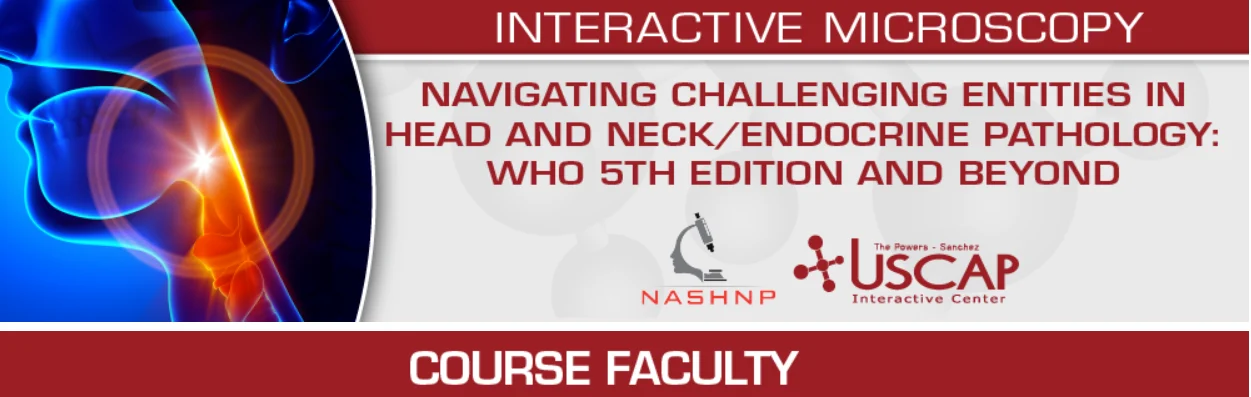
USCAP Navigating Challenging Entities in Head and Neck/Endocrine Pathology: WHO 5th Edition and Beyond 2025

Original price was: 1,349.00 $.80.00 $Current price is: 80.00 $.
USCAP Navigating Challenging Entities 2025: Review WHO 5th edition head and neck/endocrine pathology, including thyroid, sinonasal, salivary, and squamous tumor differentials.
Delivery Information: This Product is shared via google drive download link. Please use your correct Gmail address at checkout.
Please note: there are no CME points or certificate associated with this course.
Samples for Courses Can be found here: Free Samples Here!
USCAP Navigating Challenging Entities 2025 offers a case-focused review of difficult head and neck and endocrine pathology within the WHO 5th edition framework. The course connects diagnostic morphology with practical reporting, prognosis, molecular interpretation, and theragnostic considerations across thyroid, sinonasal, salivary, squamous, bone, and soft-tissue tumors.
Original release date: January 22, 2025
USCAP Navigating Challenging Entities: Course Overview
Head and neck/endocrine pathology includes a broad range of entities that can be difficult to separate in everyday practice. This course reviews concepts introduced in the fifth editions of the WHO classifications for head and neck and endocrine tumors, together with provisional entities and evolving terminology relevant to current diagnosis.
Participants review diagnostic criteria and practical reporting approaches for new and uncommon tumor types. The teaching emphasizes distinctions that affect classification, prognosis, molecular interpretation, and clinically relevant theragnostic information. The examples also reinforce how terminology, anatomic site, morphology, and clinical context work together when several entities share overlapping features.
This course is a collaboration between the North American Society of Head and Neck Pathology (NASHNP) and USCAP.
Head and Neck Endocrine Pathology: Diagnostic Focus
The diagnostic focus begins with squamous cell carcinoma subtypes and the morphologic features that help separate clinically important variants. This is paired with practical reporting considerations so that classification language, prognostic information, and relevant molecular findings can be communicated clearly.
Thyroid pathology coverage emphasizes tumor subtypes with distinctive molecular and clinical correlates. Sinonasal teaching addresses small round blue cell tumors and glandular proliferations through an algorithmic differential-diagnosis approach, helping learners organize overlapping entities without relying on a single isolated feature.
Salivary gland, mesenchymal, bone, and soft-tissue topics broaden the course beyond one organ system. Faculty-led examples connect uncommon lesions with the WHO 5th edition framework while highlighting the diagnostic features that matter in routine surgical pathology and intraoperative consultation.
Together, these topics support a structured review of difficult cases for practicing pathologists and trainees. The emphasis remains on recognizing patterns, narrowing differentials, and applying current terminology rather than on access to publisher examinations, CME credit, or certification.
Target Audience
Practicing academic and community pathologists, subspecialty pathologists, fellows, residents, and pathologists-in-training who interpret head and neck or endocrine specimens.
Learning Objectives
Upon completion of this educational activity, learners will be able to:
- Recognize the key diagnostic features for the squamous cell carcinoma subtypes.
- Recognize key thyroid tumor subtypes with distinctive molecular and clinical correlates.
- Develop an algorithmic approach to key categories in the sinonasal tract, namely “small round blue cell tumor” and sinonasal glandular proliferation differential diagnosis.
Faculty Topics
The course groups the faculty-led material into the following diagnostic areas:
- Salivary gland, sinonasal glandular, and miscellaneous pathology — Raja R. Seethala, MD
- Thyroid, bone and soft tissue, and intraoperative squamous pathology — Nicole A. Cipriani, MD
- Thyroid and squamous lesions — Doreen N. Palsgrove, MD
- Salivary, sinonasal mesenchymal, and round blue cell tumor pathology — Justin A. Bishop, MD
Why This Course Is Relevant
The program concentrates on challenging differentials that arise across multiple anatomic sites. Its faculty topics connect morphology with current classification language and help learners organize thyroid, salivary, sinonasal, squamous, mesenchymal, bone, and soft-tissue lesions into practical diagnostic groups.
This MedicalAmboss listing describes the educational content and the separately delivered files. Publisher-platform access, CME credit, MOC credit, and a certificate are not included.
Official Source
The course title, original release information, collaboration, diagnostic scope, faculty topics, and learning objectives were checked against the official USCAP eLearning course record. Access to USCAP features, CME credit, and a certificate are not included with this MedicalAmboss file-delivery purchase.
Related products

ENT / Otolaryngology
European Congress of Endoscopic Ultrasonography 11th EGEUS-ETS Congress 2025
ENT / Otolaryngology
Plastic Surgery
ENT / Otolaryngology
Scarless Endoscopic & Open Composite Plane Face-lifting Techniques 2025

ENT / Otolaryngology
plastic surgery books
Septal Surgery Challenges in Rhinoplasty ( Original PDF from Publisher + videos )
plastic surgery books